
When was the last time you hit “confirm” on a DeFi transaction and actually knew what would change in your wallet before the chain processed it? If your answer is “rarely,” then the promise of transaction simulation — showing exact token balance changes, fees and risks before signing — is worth rethinking. For DeFi power users who move assets across chains, interact with complex smart contracts, or rely on hardware wallets, simulation is not a cosmetic feature: it changes the decision point from blind trust to informed approval. This article compares Rabby’s approach to multi-chain safety with mainstream alternatives, explains the mechanisms behind its simulations and risk scans, and gives a practical framework for when that extra layer of pre-signing intelligence actually matters.
My aim is not marketing copy. Instead I’ll unpack how transaction simulation works, where it reduces real risk, where it can fail, and how to combine it with other controls (hardware wallets, approval revocation, multi-sig) to create operational security that fits a U.S.-based trader, LP, or institutional user. Along the way I’ll correct a few common misconceptions about “bulletproof” wallets and offer a decision heuristic you can use the next time you evaluate a wallet or approve a transaction.
How Rabby’s transaction simulation and pre-signature scanning actually work
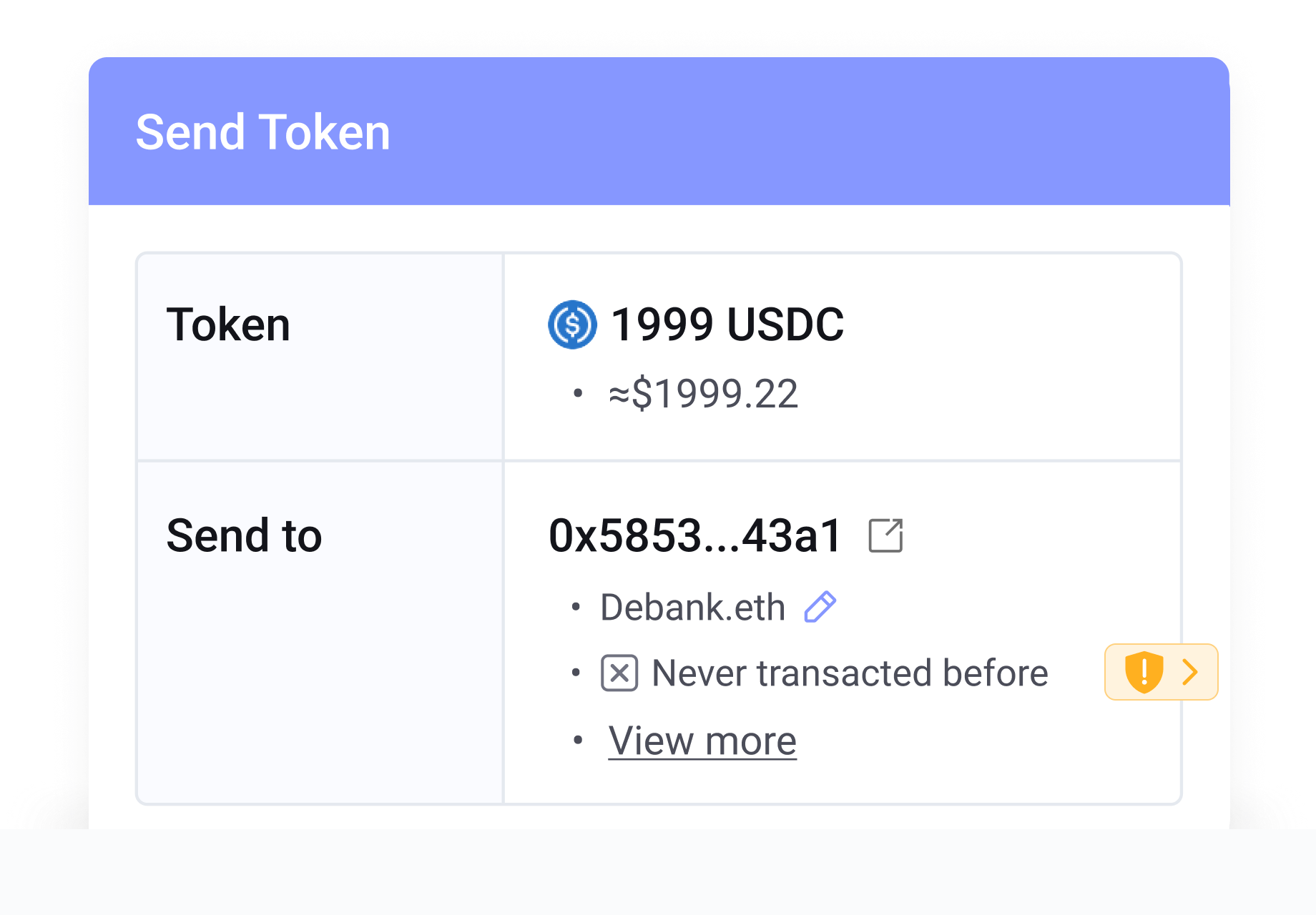
At the mechanism level, simulation means the wallet constructs the exact transaction payload you’re about to sign and runs that payload against a local or remote node (or a deterministic EVM emulator) to estimate the state changes the smart contract will make. The output isn’t a vague “ok” or “danger” flag — it is a predicted delta: token flows, approvals consumed, and gas cost. Rabby combines that simulated delta with an on-device security engine that flags contextual hazards: calls to contracts previously linked to exploits, unusually large unlimited approvals, or addresses that don’t appear to exist on-chain.
Two practical consequences follow. First, simulation prevents many forms of blind signing: you can see that a “swap” will actually withdraw tokens A and deposit tokens B, and that an approval will leave an allowance of X rather than “infinite.” Second, the security scan provides pattern-based warnings (hacked-contract history, suspicious approval patterns) that would be invisible if you only viewed the raw ABI or calldata. For power users who routinely sign multistep transactions or interact with novel protocols, that combination moves a lot of speculative risk into visible territory.
Side-by-side: Rabby vs typical EVM wallets (MetaMask, Trust Wallet, Coinbase Wallet)
Here’s a compact comparative frame that emphasizes the trade-offs that matter in practice rather than feature lists:
– Simulation and pre-checks: Rabby — built-in simulation and a pre-transaction scanner that displays exact estimated token balance changes and fees; MetaMask/Trust/Coinbase — at best show transaction details but generally lack deterministic pre-execution simulation integrated into the UI.
– Automatic network switching: Rabby detects and switches networks for visited dApps, removing a common UX hazard; other wallets typically require manual switching, increasing the risk of signing on the wrong chain.
– Hardware wallet integration: Rabby supports Ledger, Trezor, Keystone and others with deep compatibility; mainstream wallets also support hardware devices, but the combination of simulation + hardware signing is where Rabby targets a security sweet spot.
– Approval management: Rabby includes native revocation tools to view and cancel token approvals; while other wallets or third-party services provide similar tools, Rabby’s integrated approach reduces the friction of housekeeping approvals across 90+ EVM chains.
– Institutional features: Rabby integrates with multi-sig and custody solutions (Gnosis Safe, Fireblocks, etc.), which matters if you’re moving toward institutional operational processes. Many consumer wallets lack seamless enterprise integrations.
Where simulation reduces risk — and where it stops short
Simulation is powerful but bounded. It directly addresses three common failure modes: (1) mistaken approvals (you think you’re approving 100 tokens but you’re approving a contract to transfer unlimited tokens), (2) mis-specified transactions (wrong token, wrong recipient, or the dApp sending funds to a contract you didn’t intend), and (3) poor UX that leads to signing on the wrong chain. By producing concrete, human-readable deltas, Rabby reduces cognitive load in those scenarios.
But simulation cannot magically stop all losses. It cannot reverse on-chain execution; it cannot detect logic flaws in a smart contract that manifest only in unusual runtime conditions not captured by the simulation state; and it cannot eliminate front-running or MEV risks inherent to public mempools. Importantly, simulation results depend on the state snapshot used: if the node or emulator is fed stale or manipulated state data, the predicted deltas will be misleading. That’s why combining simulation with hardware signing, multi-sig for high-value transactions, and approval revocation is not redundancy — it’s defense-in-depth.
Correcting two widespread misconceptions
Misconception 1 — “If a wallet simulates a transaction, it’s safe.” Correction: Simulation reveals intent and common exploit patterns, but safety is probabilistic. It lowers exposure to classically avoidable mistakes (blind approvals, wrong-chain mistakes) but doesn’t immunize you against zero-day contract bugs, oracle manipulation, or social-engineered approvals outside the simulated path.
Misconception 2 — “Open-source wallets are automatically safe.” Correction: Open source increases transparency and enables audits, but it’s not a substitute for active security practices. Rabby is MIT-licensed and open-source, which aids third-party review, but historical incidents (the 2022 Rabby Swap exploitation) remind us that code accessibility + audit does not equal perfect safety. The team’s response then — freezing the contract, compensating users, and enhancing audits — is a practical governance signal, but not a guarantee against future issues.
Decision framework: when to prefer Rabby for your DeFi workflow
Use this heuristic to decide whether Rabby’s trade-offs align with your operational needs:
– Low-value, casual interactions (small swaps, single-chain toy contracts): any reputable wallet is acceptable; convenience and mobile support may carry more weight.
– High-frequency DeFi trading across L2s and alternative EVM chains: Rabby’s automatic network switching and simulation save time and reduce slips that cost money.
– Large-value transfers, custody or institutional deployments: pair Rabby with hardware wallets and multi-sig custody; Rabby’s integrations with Gnosis Safe and enterprise custodians make it easier to fold into institutional workflows.
– Ongoing portfolio management: Rabby aggregates tokens, NFTs, and DeFi positions across connected chains, which simplifies monitoring but remember there is no fiat on-ramp or native staking — add external services where needed.
Practical steps to use simulation safely — a short checklist
1. Always read the simulated balance delta and gas estimate before signing. The number should match your intent: amount out, recipient, and allowance changes.
2. Use hardware signing for high-value approvals and swaps; treat simulation as an additional confirmation layer, not a replacement for secure key custody.
3. Periodically run the built-in approval revocation tool to reduce standing allowances — it’s the simplest way to shrink attack surface.
4. For institutional flows, require multi-sig thresholds for asset movement and deploy Rabby in conjunction with enterprise custody integrations.
5. If you encounter a suspicious warning (hacked contract, nonexistent address), pause and research. Simulation gives a readable symptom; the correct response is verification, not reflexive approval.
For readers who want to try a wallet with simulation-focused workflows and deep hardware compatibility, you can find more on rabby and evaluate whether its combination of simulation, automatic network switching, and integrated revocation maps onto your risk profile and operational needs.
What to watch next — signals that will matter
Three near-term signals will influence how valuable pre-signing simulation becomes: (1) the growth of multi-chain DeFi activity — more chains and cross-chain bridges increase the chance of wrong-network errors; (2) institutional adoption — if custody vendors and enterprises standardize on wallets that provide deterministic pre-checks, simulation becomes an industry baseline; (3) improvements in mempool privacy and MEV mitigation — as front-running defenses evolve, the practical importance of seeing exact deltas may shift from tactical protection to auditability and compliance evidence. Each is conditional: none guarantees that simulation will be the universal solution, but each raises the conditional value of having it built into your wallet.
FAQ
Does Rabby’s simulation stop scam dApps from tricking users?
Not entirely. Simulation helps reveal what the transaction will do to your balances and whether approvals are unusually permissive, which often exposes scam patterns. However, sophisticated scams that manipulate off-chain data or exploit oracle mechanics can still succeed; simulation reduces certain classes of risk but is not a universal guard.
How should I combine Rabby with a hardware wallet for maximum safety?
Use Rabby’s UI and simulation to inspect the transaction and then approve the same transaction on your hardware device. For very large or multi-step operations, require multi-sig. Treat the hardware wallet as the root of trust and Rabby’s simulation as a decision aid rather than the final security control.
Does Rabby support all chains and DeFi primitives?
Rabby supports over 90 EVM-compatible chains including the major L1s and L2s, and it aggregates DeFi positions across them. But it does not currently include a fiat on-ramp or native in-wallet staking. If you need fiat rails or native staking, plan to use external services alongside Rabby.
Given Rabby’s 2022 incident, is it safe to trust it now?
Security is about processes, not absolutes. The 2022 exploit led to a concrete incident response and compensations, and Rabby has since expanded audits and safety tooling. That improves confidence, but prudent users still combine multiple controls: hardware wallets, approval revocation, small test transactions, and multi-sig for high-value flows.
Final thought: simulation changes the human-computer interaction in DeFi from an act of faith to an informed judgment. For power users operating across chains, that shift is meaningful — but it only pays off when combined with strong custody, disciplined allowance management, and an institutional mindset about transaction approvals. Use simulation to ask better questions of every signing prompt, and let those answers guide when you move funds, approve contracts, or scale an operational process.

